
Identify Who Owns Ingham Property
Finding who owns an Ingham County property takes two records, not one. First link the street address to the assessor's parcel record. That record names a likely owner of record. Then test that name against the newest recorded deed. The deed index shows the actual transfer, so it settles the question. A parcel map or GIS layer helps confirm both records describe the same land. You can also search Ingham County property records by address. That skips straight to the parcel number. The method suits purchase checks, estate research, and deed-fraud review. It will not tell you who lives there. It never replaces a current title examination either.
- Enter the street address in Ingham County BS&A.
- Copy the parcel number, Property Address, and Customer Name.
- Search the Customer Name in the free Direct Search deed index.
- Open the most recent matching transfer and compare its legal description.
- Resolve an entity, trust, or estate label through the proper public filing.
Ingham Owner Sources Compared
Four official systems each answer a different piece of the ownership question in Ingham County. None of them is a list of occupants. The assessor is fast and parcel-centered. The deed index tracks transfers instead. GIS is spatial. Michigan's business registry fills the gap when the grantee is a company or other entity.
| Source | Owner evidence | Access route |
|---|---|---|
| Ingham BS&A | Customer Name tied to address and parcel | Address, name, or parcel search |
| Register Direct Search | Grantor and grantee on recorded instruments | Free index; image by Tapestry, Laredo, or copy request |
| FetchGIS | Parcel position and identifiers | Free county viewer |
| MiBusiness Registry | Official entity filing trail | State business portal |
A mailing address may belong to an owner, a tax agent, a trust, or a company. It can help route a property question. It does not establish residence.
Read the Ingham Customer Name
The Ingham County BS&A portal labels its displayed name "Customer Name." One East Lansing record for 1350 Haslett Road shows RUSSELL BUILDERS INC beside parcel 33-20-02-07-406-005, along with a Property Address, values, and a building summary. The sample shows the local field labels. It does not prove that the screen reflects a deed recorded moments earlier.
The county sample appears below, so the owner clue can be read in context rather than copied alone.
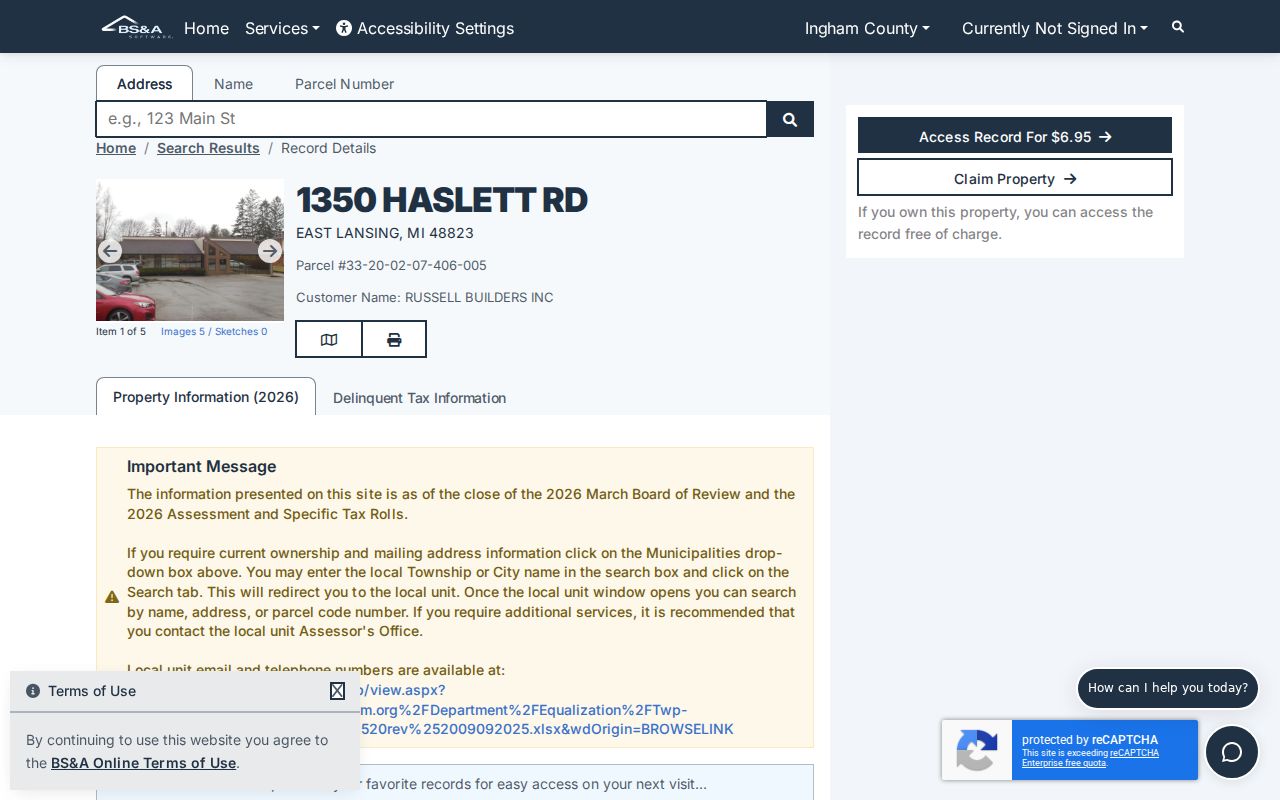
The parcel number is the best key to carry forward. Match it with the legal description and the newest deed before stating who owns the land.
Confirm Who Owns by Deed
For a free look at the deed side of Ingham County records, the Register of Deeds Direct Search is the place to start. Run the name from the assessor roll. Try the usual spellings and variants while you are at it. When the results come back, pick the newest transfer. It should be tied to the parcel or its legal description. Note the details that matter. Note the grantor, grantee, instrument type, and recording date. Also note the liber and page or instrument number, and the land description itself.
One catch. The index skips the last seven days. A closing that fresh may call for the Register of Deeds office. It may also call for a paid image instead. Tapestry covers images from 1960 forward, charging $8.95 per search plus $1 per image page. You can also request a recorded copy straight from the office. Index and image are simply two layers of the same Ingham County property record.
Ownership terms
Owner of record is the name a public record shows at a given time. A grantee is the party who receives an interest in a deed. Vesting describes how that interest is held. The situs address pins down the property itself. A mailing address just tells the county where to send the tax bill.
When an Ingham LLC Owns
An LLC or corporation name is not a dead end. Copy it exactly, with all punctuation and suffixes, from both BS&A and the deed. Then search the Michigan MiBusiness Registry. Michigan launched the registry in June 2025. It provides business searches, filings, certificates, and copies.
The filing identifies the legal entity behind the recorded name. It does not move title. You should never swap an officer or registered agent for the grantee. County assumed-name or DBA filings may matter too. A state entity and a local assumed name are not interchangeable. Keep the entity record, the deed, and the parcel result as three distinct sources.
Trust and Estate Owner Clues
A Customer Name ending in trustee, survivor, executor, administrator, or personal representative opens another record path. The deed may cite a trust certificate. It may cite proof of death instead. Ingham Probate Court may hold the will, the appointment, an inventory, or a petition to sell. It may also hold a sale confirmation or conservatorship authority that explains the transfer.
Probate files are open to view at the public filing office. Requests go through in person, by mail, fax, phone, or email. Copies cost $1.50 per page, and certification adds $10. Older research reaches further back. The FamilySearch catalog lists Ingham probate indexes from 1835 to 1933. It also lists probate records from 1840 to 1904. Read the estate authority alongside the recorded transfer. Do not guess ownership from a family name.
Search Ingham Name Variants
Name indexes match letters, not intent. A surname can hide behind initials, stray punctuation, or a prior married name, so try every plausible variant. Entities deserve the same skepticism. An assumed name filed through the County Clerk may not match the registered entity at all. Trusts need the trustee and the trust name.
Older Ingham deeds deserve a second look. The online index reaches back to 1956. Records from 1956 through 1981 carry a conversion-discrepancy warning, and the county calls 1982 forward the proven-accurate era. For pre-1960 material, book a vault appointment in Mason, where public computers and older books give a fallback when an online search returns nothing.
Cross-Check the Ingham Parcel
FetchGIS tests whether the deed, the assessor result, and the street address describe the same land. Pull up the parcel first. Compare its parcel number, shape, nearby streets, and any legal-description clues against the paperwork. A lot-and-block record points to the recorded plat. Metes and bounds is different. Never infer a line from screen geometry.
County GIS supports parcel selection, measurement, and reports, but the county states plainly that it is neither a boundary survey nor the official record. City lines add their own trouble. Lansing, East Lansing, Mason, and township addresses can carry a postal city, ZIP, assessor jurisdiction, and legal boundary that disagree with one another. The deed description controls.
Note the municipality attached to the parcel. Lansing mail routes run past the city line, East Lansing's annexation history leaves older deeds under township geography, and Mason's 48854 postal area does not prove city jurisdiction. When a city assessor search stalls, use county FetchGIS and ask Equalization which local unit keeps the roll.
Property Fraud Alerts in Ingham
Ingham County offers a free watch service through Property Fraud Alert, built around a monitored name. An alert tells you one thing. The name appeared on a recorded instrument. It does not block that instrument, prove fraud, or settle who owns this property.
Act on the alert calmly. Open the official deed index, note the instrument reference, and call the Register of Deeds at its independently published number. Save the alert, the image, and the check time. The county fee schedule guards against inflated private solicitations. Recorded copies run $1 per page. A certified copy costs $5 per document plus $1 per page.
Never treat the alert email as the record. Confirm the domain, pull the indexed document through the county route, and ask the Register what its filing data shows. A common name can tie an alert to a different person or parcel, so the legal description and instrument number matter most.
Limits on Ingham Owner Findings
A public record answers ownership narrowly. It names the customer on the roll or the grantee in a recorded deed. It cannot prove who occupies the site, expose an unrecorded interest, or resolve every title defect. Report conflicts as conflicts, source and date attached.
Lawful use. Owner records support purchase checks, estate work, deed-fraud review, and boundary communication. Never use a name or address to stalk, harass, intimidate, or harm anyone.
Michigan's Address Confidentiality Program shields qualifying survivors with substitute addresses and mail forwarding. Public parcel data does not unlock protected voter details. Restricted information stays restricted even when a parcel address is open. Keep owner research tied to a real property question.
For a purchase, easement, inheritance, or contested transfer, save the assessor result and recorded deed as evidence. Then obtain the professional review the matter requires. A clear note states what each source showed and when it was checked. It also notes why any mismatch remains unresolved. Copy as little personal data as possible.