
Read an Ingham County Current Owner Card
The Ingham County BS&A portal accepts three search keys: Address, Name, or Parcel Number. Owner data appears in a field labeled Customer Name. That label helps, but it does not settle title. Read it beside the property address, parcel key, roll year, and any deed or sale reference shown on the card.
| Customer Name | The person, LLC, trustee, or representative displayed on the roll |
|---|---|
| Mailing Address | The destination used for assessment or tax correspondence when shown |
| Property Address | The situs tied to the parcel, which may differ from mailing information |
| Parcel Number | The cross-system key for GIS, assessing, tax, and deed research |
| Roll Year | The assessment year that dates the displayed information |
| Deed Reference | A lead to the recorded instrument when the detailed record supplies one |
A Customer Name is not proof anyone lives at the property. An out-of-area mailing address can be routine. Entities, trustees, and owners who receive mail elsewhere all produce them. Keep the exact field labels. Rewriting them as title facts overstates what the portal claims.
The sample parcel card shows the pattern. Customer Name RUSSELL BUILDERS INC. Situs 1350 Haslett Road. Parcel number 33-20-02-07-406-005.
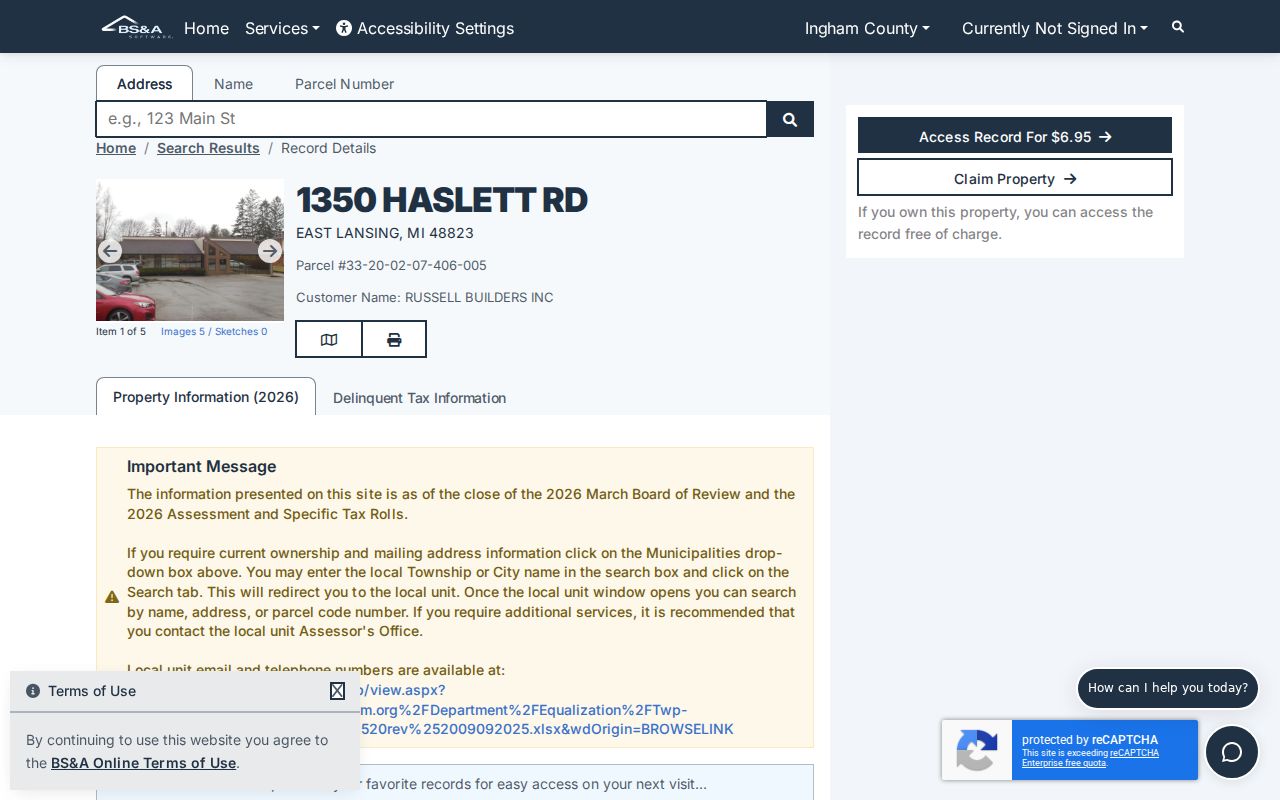
The sample card illustrates the record format only; always recheck the live portal before reporting a current owner for any Ingham County parcel.
Define Current on the Ingham County Roll
Current here means current for the roll, not the minute. Portal views have shown both 2025 and 2026 headings. The county publishes no standard deed-to-assessor update lag. Save the roll year, retrieval date, and source URL with the name.
A closing comes first. The deed is recorded next. The local assessment record changes later. Michigan transfer rules may also shift taxable value in the year after a transfer. Those events form one chronology, not one moment.
Note: Ask the property's city or township assessor about a specific parcel and transfer instead of assuming an average update delay.
Check the Newest Ingham County Deed
The Register of Deeds Direct Search is the free index route for a name and a document reference. It skips the most recent seven days. A brand-new transfer may need the office itself. Tapestry sells image access at $8.95 per search plus $1 per printed page, and Laredo serves regular subscribers.
Match the deed's grantee, recording date, legal description, and parcel reference against the assessment card. An index hit is not the deed image. A recorded instrument is not a title opinion. Copies can also be requested at 341 South Jefferson Street in Mason, where counters are open Monday through Friday, 8 a.m. to 5 p.m.
Separate Ingham County Mailing and Situs Addresses
The situs describes the property being assessed. The mailing address routes notices. It may point to another home, a business office, a trustee, or an agent. A mismatch is a clue for verification, not proof of error or vacancy. So anchor every check to the parcel number and legal description.
Postal city and municipal jurisdiction can differ too. Lansing, East Lansing, Mason, and township assessors all keep local rolls inside the county system. Confirm the assessing unit listed for the parcel. Do not pick an office by ZIP code.
Interpret an Ingham County LLC or Trustee Name
An LLC suffix points the next check to Michigan's MiBusiness Registry, which launched in June 2025. The registry covers entity searches, filings, certificates, and copies. The record can confirm a formal name. It also shows filing context. A registered agent is not automatically the property's beneficial owner.
A trustee, survivor, or personal representative label may require a deed. It may also call for a certificate of trust, death proof, or Probate Court file. Ingham Probate records can be viewed at the public filing office. Requests work in person, by mail, fax, phone, or email. Read the authority and the conveyance together instead of converting a role into personal title.
- Owner of record
- The party shown by the relevant official record at its date.
- Vesting
- The language describing how a deed places title in a grantee.
- Situs
- The physical address assigned to the assessed parcel.
- Recording lag
- The unknown interval between a recorded transfer and a later roll update.
Save the Ingham County Roll Year as Evidence
A defensible owner note records more than a name. Include the parcel number, property address, exact Customer Name, mailing address when shown, assessing unit, roll year, search date, latest deed number, recording date, grantee, and legal description. A name alone cannot reproduce the result.
Sometimes the roll and the deed disagree. Report both dates, and ask the local assessor or the Register of Deeds which update is pending. Never silently pick the source that fits an expected answer.
Keep the public access channel in mind too. BS&A is the online assessment route, though details can be fee-gated for someone not claiming a resident-owned parcel. A local assessor answers roll-specific questions. The county Equalization office explains assessment classes, subdivisions, dimensions, school districts, rights-of-way, and mapping. Equalization cannot change an individual's owner entry or assessment.
The Register of Deeds offers fallbacks when the free index falls short. Options include Tapestry images, a Laredo subscription for regular searchers, public courthouse computers, and in-person or requested copies. Online images begin in 1960. Pre-1960 work requires a vault appointment. These routes matter when a deed reference appears on the parcel card but a usable image does not.
A screenshot should show the source URL and retrieval date. Expose no more personal data than the question requires. Anyone reproducing the check needs the parcel number and instrument reference, not an unneeded mailing address.
Use Ingham County Property Fraud Alert Carefully
The county points homeowners toward Property Fraud Alert, a free service that sends a notice when a name you monitor shows up in a recorded instrument. That is all it does. An alert cannot stop a filing, judge whether a document is fraudulent, or say who the current owner of record truly is.
Treat any alert as a prompt to check things yourself. Open the Register of Deeds page on your own, call 517-676-7216, and compare the document number against the official copy. Skip any phone number or address printed in a letter that raised the alarm.
Confirm the Current Ingham County Owner
Confirmation is a two-record comparison, not a portal tour. Start with the parcel card, then test it against the newest recorded conveyance affecting the same legal land.
- Find the parcel in BS&A and copy the Customer Name, situs, parcel key, and roll year.
- Search that name and parcel clues in Direct Search, allowing for the seven-day exclusion.
- Read the newest deed image for grantee, recording date, legal description, and vesting language.
- Resolve any LLC, trust, estate, or date mismatch with the appropriate entity, probate, assessor, or recorder source.
- Grantee
- The party receiving the interest described by a deed.
- Instrument number
- The recorder's reference used to retrieve and cite a document.
- Registered agent
- An entity's official service contact, not necessarily its owner or the landowner.
Use Ingham County Owner Information Lawfully
A public mailing field can support a legitimate property inquiry, deed correction, boundary discussion, or purchase question. It does not prove anyone lives there. Nor does it invite intrusive contact. Michigan's Address Confidentiality Program gives qualifying survivors a substitute address and mail forwarding, though its application system is not a public lookup.
Lawful use. Use Ingham County owner records for legitimate property matters. Never use a name or address to stalk, harass, intimidate, or harm anyone.
An assessment search is not a title search. When legal ownership controls a transaction or dispute, obtain the recorded documents and appropriate professional review. Michigan FOIA can reach sufficiently described public-body records. Court files follow court access instead. Use the dedicated property systems first, then request only a record the portals and office copy routes do not supply.