
Deed Types Recorded in Ingham
Land instruments in Ingham County live with the Ingham County Register of Deeds. When a deed arrives, the office records the transfer. Type, parties, legal description, and reference then explain what changed hands. Recording does not guarantee title.
| Deed Type | What It Does | Common Use |
|---|---|---|
| Warranty deed | Conveys an interest with stated covenants | Many sales |
| Quitclaim deed | Conveys whatever interest the grantor holds | Family or cleanup transfers |
| Land-contract deed | Completes a contract-based conveyance | Installment transactions |
| Trustee or representative deed | Shows a fiduciary acting under authority | Trust or estate transfers |
| Sheriff or tax deed | Records a statutory-process transfer | Foreclosure or tax matters |
Not every indexed instrument conveys land. A mortgage secures debt, an easement grants a stated use, and a lien asserts a claim. Reading the instrument type first prevents mistaking a name for a former owner.
Ingham's Grantor-Grantee Road
Start a chain search in the county-linked Direct Search, the free index route. Look up the present owner as grantee. That deed's grantor becomes your next prior party. Try initials, spelling variants, trustee names, and entity forms as you go.
- Find the current party's acquiring deed.
- Read the grantor, description, date, and reference.
- Search the grantor as an earlier grantee.
- Repeat to the cutoff, then continue in deed books.
- Grantor
- The party conveying an interest.
- Grantee
- The party receiving it.
- Chain of title
- The linked sequence of ownership instruments.
- Book/page or instrument
- The retrieval reference.
Obtain an Ingham Deed Copy
Images span 1960 to the current effective date. On Tapestry, each search costs $8.95 plus $1 per page. Laredo serves subscribers instead. The county prices plain copies at $1 per page and certification at $5 plus $1 per page, so confirm current charges before paying. The Mason office provides counter help, public computers, mail and copy-request channels, and vault access by appointment. Anything before 1960 requires the vault route. Bring the recording reference, names, date, and legal description.
Recorded, not guaranteed. Ingham deed records show accepted instruments, not a title opinion. Unrecorded interests and later documents may matter.
Three Ingham Deed Routes
The official online-records page splits access three ways: Direct Search, Tapestry, and Laredo. The free index identifies records, Tapestry suits occasional image buyers, Laredo supports subscription work, and the Mason vault covers older books.
| Route | Best use | Limit |
|---|---|---|
| Direct Search | Free party index | Not the deed image |
| Tapestry | Occasional images | Search and page fees |
| Laredo | Frequent research | Subscription |
| Vault | Pre-1960 books | Appointment |
Use the official page to confirm the live effective date.
The Ingham 1956 Caveat
Coverage has limits. Indexing begins in 1956 and images in 1960. The county cautions that converted indexing for 1956 through 1981 has not been proven accurate; the proven-accurate era starts in 1982. Empty early results call for name variants and direct inspection. The coverage notice displays that warning.
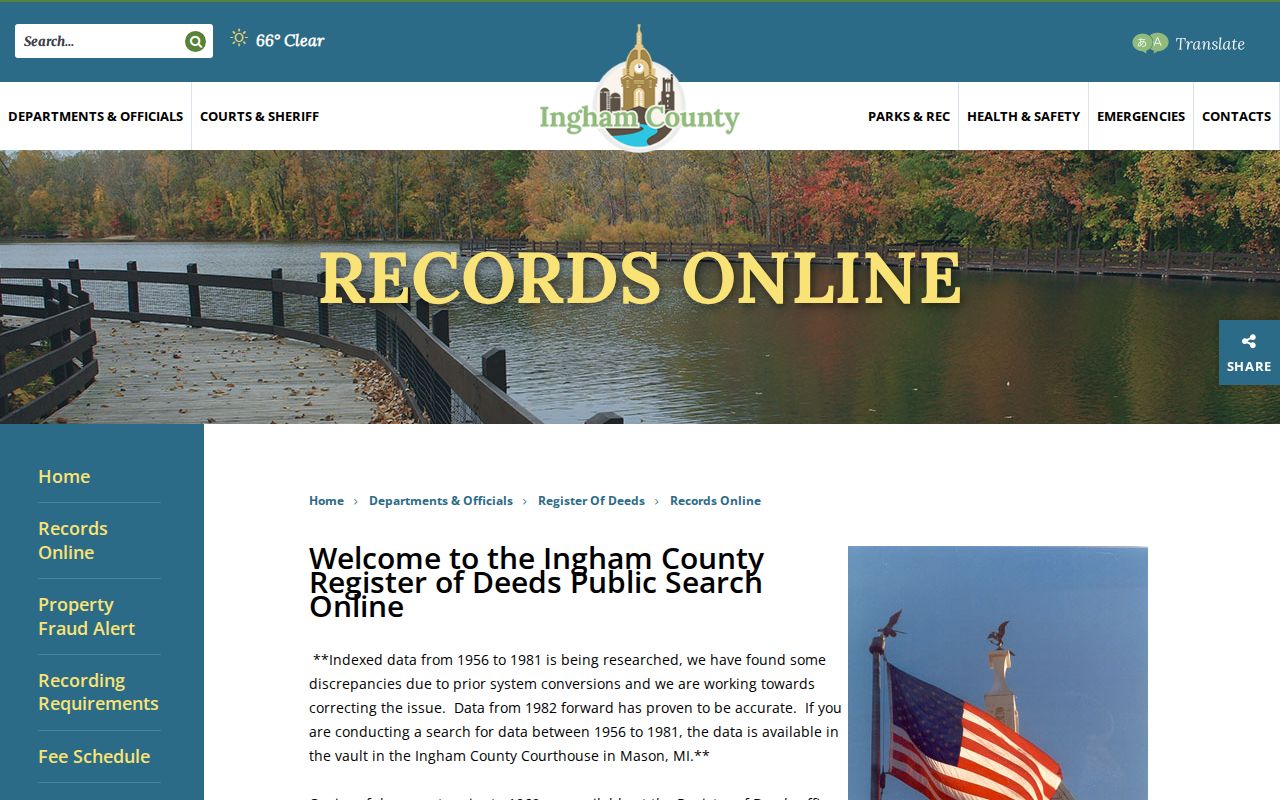
The screenshot shows when online retrieval should give way to a Mason vault appointment.
Ingham Deed Search Fields
The practical search keys are party name, document type, recording date range, and reference. Legal descriptions separate same-name hits. For trusts, estates, and companies, search each form of the name.
| Field | Purpose | Issue |
|---|---|---|
| Grantor | Outgoing conveyance | Trustee or entity form |
| Grantee | Acquiring deed | Initials and order |
| Date | Narrow period | Signed and recorded dates differ |
| Type | Separate deeds from liens | Labels vary |
| Reference | Retrieve item | Systems vary by era |
Start broad, then narrow with dates and description.
Ingham Transfer-Tax Clues
Michigan recording rules govern signatures, addresses, acknowledgment, and document form. Some deeds carry transfer-tax or consideration figures. Those numbers describe the transaction, not an assessed value or an appraisal. The county fee schedule lists a $30 recording fee for a document assigned one liber and page, plus transfer taxes and certification charges. Staff record compliant documents. They do not choose a deed form or give title advice.
Ingham Mortgages and Releases
Every Ingham County parcel can carry two parallel chains. One tracks ownership, and the other tracks debt. Mortgages name borrowers and lenders. Assignments move lender interests, and discharges or releases record later action. A mortgage lacking an online release does not, by itself, prove a balance remains. Search borrower, lender, assignee, and reference, then compare legal descriptions. An indexed lender name never makes that lender a former owner.
Ingham Property Fraud Alerts
Property Fraud Alert notifies enrolled users when a chosen name appears in a recording. Enrollment does not stop a filing. It also does not prove a document valid. An unexpected alert calls for inspection. Follow up with a call using verified county details. Before paying a private sender, compare unsolicited copy offers against the official fee schedule.
Probate in Ingham Deeds
After a death, a survivor, trustee, or representative may convey land. The deed itself may not spell out the full authority behind the transfer. Recording requirements address proof of death. Probate Court records can show an appointment or estate order. The FamilySearch Ingham probate catalog lists 1835-1933 indexes and 1840-1904 records. Treat it as a finding aid. Confirm anything against county originals.
Read Ingham Land Descriptions
Addresses help you search. The legal description identifies the land conveyed. Subdivision property may use lot and block; older tracts often rely on metes and bounds. An easement may describe only a strip or a limited right. Compare the text of each transfer. Parcel splits and combinations can break a simple modern match. A GIS map orients research and plats explain geometry. But neither replaces deed text or a survey.
Verify Recent Ingham Deeds
Direct Search holds the newest seven days out of assured results. After a recent closing, check the live effective date. Contact the office rather than assuming the latest deed is final. Keep execution and recording dates separate. Parties may sign long before recording. A later corrective deed or affidavit can also change the sequence.
Ingham Deed Copy Costs
The line between an index and a document controls cost. Direct Search yields a free index lead. Tapestry charges for the search and for downloaded pages. The county fee schedule sets plain and certified copy charges. Laredo serves a subscription workflow. Confirm the current effective date and price before ordering. A certified copy authenticates the document as an office record. It does not guarantee the instrument created good title. Request certification only when a court, agency, or transaction requires it. For preliminary house-history work, an index reference or plain image may be enough.
Ingham Vault Research Preparation
Deed work dating back before 1960 happens at the Register of Deeds vault in Mason. Visits run by appointment. Start from the newest instrument you trust. Bring its book and page, the party names, and the legal description. Add a rough date for the prior conveyance. Staff will grant access and assist where they can. Sorting out same-name parties and linking the land across decades stays with the researcher. Public computers, mail requests, and copy orders are other routes into the same records. The official office page posts current hours and procedures. Ask for one specific volume and page rather than a full chain built from nothing. A precise request gets a usable answer.
Ingham Deed Recording Rules
The county recording requirements cover signatures, printed names, addresses, acknowledgment, margins, return details, and transfer documents. They matter more than filers expect. A rejected instrument never enters the public chain on schedule. Register staff judge whether a document meets those standards for recording. They will not pick your deed type. They will not settle an ownership fight. They will not hand out a title opinion. For advice on legal effect, talk to a Michigan attorney or title professional. Do that before you present anything for recording.
Follow Ingham Description Changes
Deed chains rarely sit still. They cross parcel splits, combinations, new subdivisions, and boundary adjustments. Whenever a legal description shifts, figure out what the conveyance moved. Did it carry all the land, one newly platted lot, or a slice of an older tract? Never assume today's parcel outline existed earlier in the chain. Recorded plats and the prior deeds form the documentary bridge between old and new descriptions. FetchGIS can sketch the current configuration. Its lines are neither an official record nor a survey. Keep the old and new descriptions side by side with the instrument that made the change.
Distinguish Ingham Party Roles
One surname can surface in many roles. The index lists grantors, grantees, borrowers, lenders, trustees, personal representatives, witnesses, and notaries alike. Only the instrument itself and the party role explain why a name was indexed. Adding every name to an ownership chain invents false former owners. So read the caption and the granting language closely. Deeds belong on the ownership timeline. Mortgages and their assignments go on a debt timeline. Easements go on a rights timeline, and a discharge touches only the secured interest without moving the land. That separation matters most with a bank or servicer appearing repeatedly in the parcel's deed records.
Ingham Deed Search Gaps
A missing deed usually means a search problem, not a gap in the records. Test alternate spellings, initials, married names, entity forms, trustee capacity, and a wider recording range. Pull the legal description from the next verified deed and compare. The 1956-1981 conversion period deserves extra care. The county's own accuracy warning makes image or vault confirmation essential for those years. Probate, survivor, land-contract, sheriff, and corrective instruments can all break a tidy warranty-deed pattern. Search related parties and document types too. And remember the limits of an online query. An empty result proves only that the accessible index returned nothing, not that no instrument exists.
Document an Ingham Deed Chain
For every link you establish, record the details. Save the recording date, grantor, grantee, document type, book and page or instrument number, legal description, and image source. Also record the date you searched. Flag unresolved links instead of smoothing them over. A timeline that admits uncertainty beats one built on quiet assumptions. When a chain will back a purchase, a court filing, an estate, or a boundary decision, bring in a qualified title professional. That professional should examine the official instruments and any competing interests. Public deed records supply the evidence. A self-directed index search, though, is not a title examination.